
Study Away Highlight #1

Hello! It has been a bit because I have been in the British Aisles. I restarted this blog this summer because I had to write "blogs" for my study away class anyways, so I figured I would post them here. These will not be like my typical blog post previously because there are specific prompt for educational purposes, but I still hope you enjoy. I still want to post them here though!
In order to not bombard you and to highlight my favorite writings and/or moments I will post sections at a time, but these will be LONG. Additionally, stay tuned for my second feature length script being published soon and a new photography section at the end of this trip.
September 2nd, Newgrange
I am not a religious person by any means, but Newgrange was a spiritual experience. It connected to emotions I have never felt before regarding my history as a person, or even just as a physical being. The closest I have felt prior to this unique experience is related to my ethnicity and my interests. The first is whenever I taste my Dad’s Romanian cooking after not eating it after a while. I feel the rush of generations who had lived before us, spiritually connecting to my culture. The other is when I was looking at the various cameras in the Museum of the Moving Image. That time I felt spiritually connected to the art form more than any other exhibit I had ever seen before. I felt like I was continuing the tradition that only call to a select few. Those few are the ones who have the gut instinct to pick up the camera and film. Filming not just for recreation, but for art’s sake.
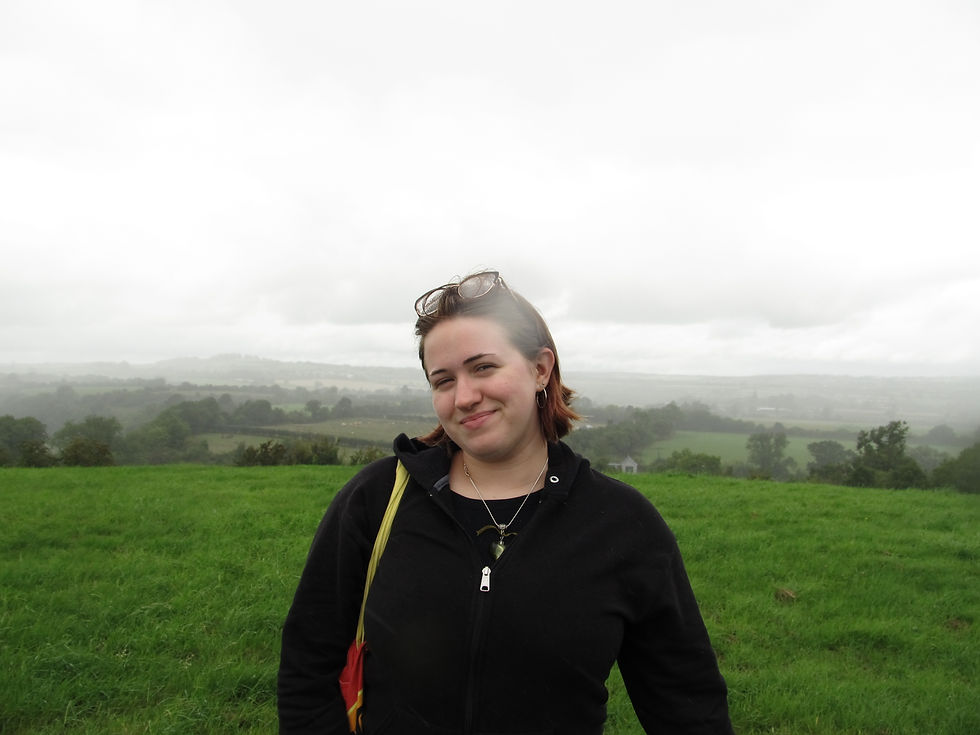
This experience reminded me that outside my ethnicity and passions, that, above all, I am human. It made me emotional in a way I have never experienced. It reminded me I am lucky to have the passions I have, which I just briefly described. I was born in a time where I have the privilege to be able to find joy in filmmaking and film consumption, coding, and my traditions.

Additionally, as much as I love my passions, a life where you would watch the sun rise in that small space seems divine. In some ways we can never recreate the work that we have done in our past. The construction of that small, beautiful building is so durable against the rain when modern human technology continuously fails. I stood inside there dry and cool, but my new umbrella inverts against a little wind.
Learning the afterlife traditions in there almost felt comforting, despite the overwhelming feeling of death I have hope. We have given those that laid to rest there a new life in a memory that will live on in us and everyone we tell this experience to. This pattern will continue until we as humans end.
Another thing that made me feel connected was all of the graffiti. I know that people actively destroyed an ancient, historic monument, but at the same time it is an adorable habit for us as humans. We all want to leave our mark whether it is cave drawings, scratches of initials in a tree denoting love, or the giant King Kong art or various other graffiti throughout Dublin. We all just want to be remembered whether it is a culture, passion, experience, place, or simply a life.
September 2nd, Mellifont Abbey
Visiting Mellifont Abbey was a wonderful experience with truly stunning architecture that stood the test of time. It makes me appreciate the natural ways they had to create such works of beauty. I took many photos here. I thought the way the light entered, or did not enter certain places made it darker and more mysterious, despite the fact that we were quite literally being told the history and it was one of lives devoted to work and religion. I never thought I would have connected this experience to my Earth Systems course, but that’s the beauty of life.

I am not the most confident in my knowledge of minerals, mineral resources, and rocks, but having taken an Earth Systems course, I can recognize some language concerning said topics. In the Abbey, I remember the tour guide describing the usage of slate for the building. Slate is a type of metamorphic rock. Metamorphism is the changing of rock types through mineralogical, textural, structural, and chemical changes of conditions different from where they were formed.
These changes are a result of different temperatures and/or pressures. This is all a part of the rock cycle. The metamorphic processes can causes many changes in rocks, which included a higher density, growth of large crystals, banded texture, foliation fabric, and changing into another mineral. More information on slate is that it forms from a low-grade of metamorphism, meaning low pressure and temperature. They come from mudstones and shales, which are like silt and clay. Slate has a slaty cleavage, meaning rock cleavage with planes of weakness between the minerals.

I thought it was fascinating that this topic would come up, as I really enjoyed Earth Systems and my Earth System’s professor, who ironically enough, is from the British Isles. The Abbey’s building itself had a man-created class division wall. Construction in that time was much harder and more labor intensive. Machines alone most likely cut time tenfold. The important note is that they didn’t just use the slate and rock, put it on the slab, and call it a day. There was intentionality and in the ruins you can see the shadow of what once was.
Nowadays the construction and general materials required to construct a building seem detached from the Earth with the cotton-candy-like look of wall insolation to the sludge like appearance of cement. That building had a story, not just historically, but physically and socially. I think it may be harder to tell moving forward through time with the gingerbread style buildings much of industrialized society has, but the Abbey at least was nature and history at its best. In total, I thought it was truly interesting that Mellifont Abbey and my Earth Systems class intersected the way it did!
September 3rd, National Printing Museum
In the printing museum, I actually got to physically operate the printing device. The unfortunate/fortunate part is that I actually had to print three separate times, even though I only did my last name, but if you couldn’t tell it is quite long and confusing to most (Raileanu).
This process was confusing because my last two letters of my last name, n and u, are visually similar. They are just flipped. The first time I did it, the print came out Raileauu. I accidentally placed the n wrong because I grabbed the wrong n/u. Then the printer fixed it by swapping one, but then she swapped the wrong one and it came out Raileaun. I felt very bad at this point, but we had finally figured out a quick and easy way to end on Raileanu.

The physicality of rolling the machine was much harder than I thought it would initially be. If you have ever used any arm curling machine, it felt quite similar. As I repeated the process three times, I had gotten pretty good at it by the end. The woman working the printer had ink on the table next to her and would roll a roller in there to grab more ink for each print, and then roll the roller on the lettering.
By physically printing and dealing with mistakes it made it very easy to understand why certain corners were cut, or things happened. My friend Regan and I joked after my printing that instead of minding ps and qs (a phrase that came out of printing about how similar they look) that you need to mind your ns and us.

Looking at The Proclamation of the Irish Republic with the physical knowledge I have made it easy to understand how and why certain changes, or mistakes happened. For instance, many letters had to be altered because of the removal of some letters. When you stare at the letters available for printing instead of looking like the letters they turn into shapes, and you have to pay attention to shape language more than anything. They had to use a o for a c, and scratch out a section. You can really understand how that makes sense and was the correct choice after looking at the “shapes.”
Additionally, there is a typo in the document with an e being upside down. Printing is incredibly hard to wrap your brain around, granted I’m saying this with my modern perspective. After a certain amount of time I am sure the words don’t read as words anymore, like I was saying with the shape language, but this time I mean unintentionally. I can certainly attest that flipping a letter and making mistakes is easy. Physically operating anything really makes a difference in knowledge. For example, in my coding experience I can be lectured all day, but there is a huge difference between learning about algorithms versus constructing one for your code. I really loved the print museum and the hands-on encounter was rewarding and taught me so much. I am excited to bring that knowledge back with me when I return and talk to one of my favorite professors I had who specialized in printed art!
Well, that's it for now. I hope you enjoyed. Stay tuned for another highlight sometime soon. (Hopefully) somewhat soon I will post my last final non-study away post. It should be interesting. I really like it and I hope it takes off. You'll see later.
Comments